
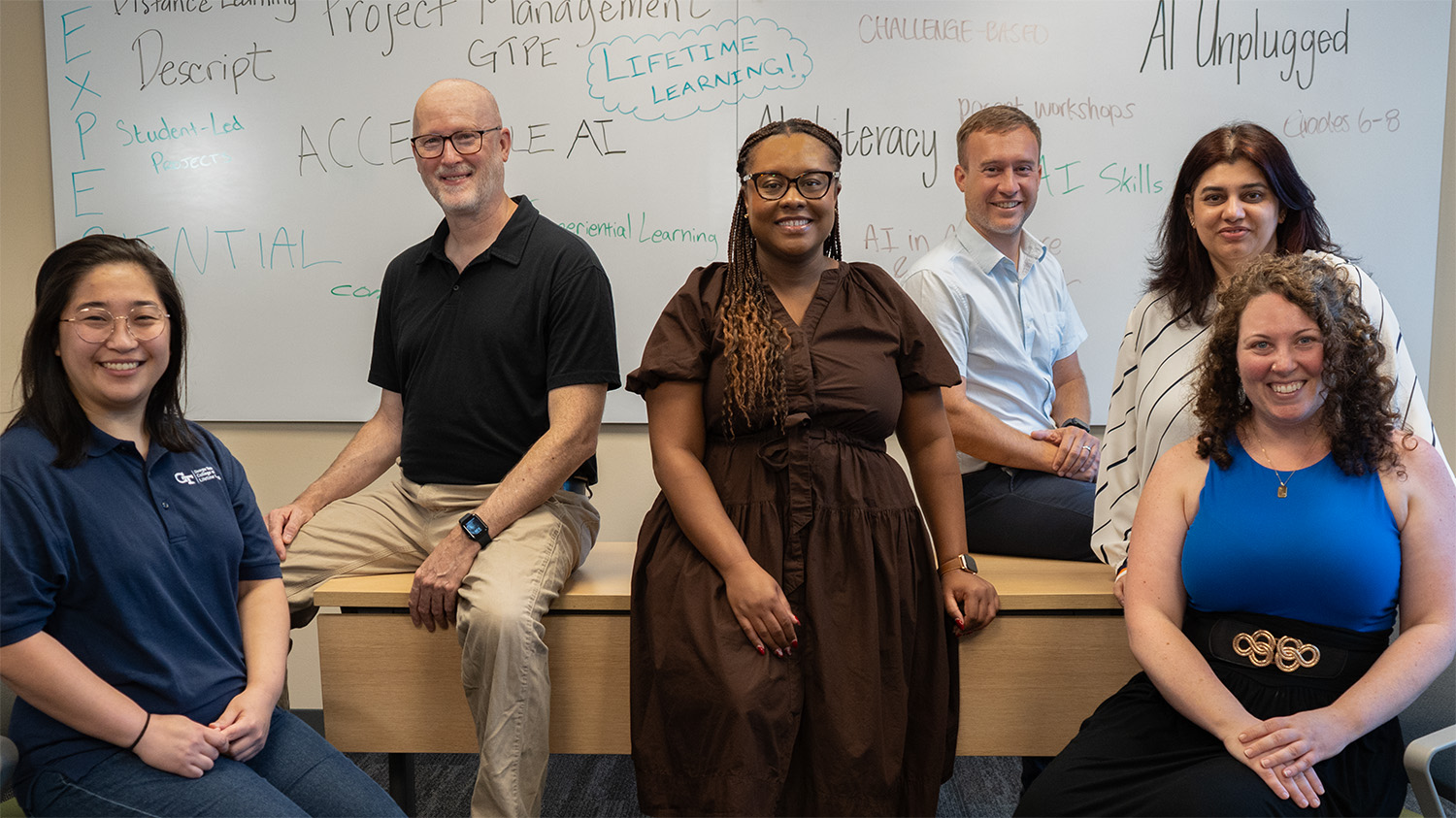
Four projects featured in Georgia Tech’s Academic AI Playbook highlight how the College of Lifetime Learning is applying emerging technologies across teaching, learning, and online course development.
From AI literacy initiatives to AI-assisted course development, Georgia Tech is exploring new ways to help learners understand and benefit from emerging technologies. Recent projects in the College of Lifetime Learning show how these efforts are taking shape across the Institute. The first Georgia Tech Academic AI Playbook highlights them in four featured articles.
Expanding Access to AI Education
Assistant Director of the EXCEL Program Nathan Heald, K-12 InVenture Prize Director Danyelle Larkin, Senior Research Scientist Abeera P. Rehmat, Web Developer Love Park, and doctoral candidate Rachel Lowy in the College of Computing piloted approaches to making emerging technologies more accessible to learners who may face barriers to participation.
In Innovative Pathways: Unplugged AI in Manufacturing and Agriculture for Middle School Learners, Larkin, Rehmat, and Park describe an initiative they led for Georgia Artificial Intelligence in Manufacturing (Georgia AIM) that expands access to AI education for middle school students in rural and resource-limited communities. The curriculum provides educators with a framework for introducing AI concepts without requiring computers, coding experience, or reliable internet access.
“We designed it to make AI concepts accessible through hands-on, device-free learning,” said Larkin. “Through challenge-based activities grounded in agriculture and sustainability, students explore how AI can support human creativity, decision-making, and systems thinking.”
In Teaching AI Literacy and Self-Determination for Students with Intellectual and Developmental Disabilities, co-instructors Heald and Lowy explain how their EXCEL course, AI Skills for Life, helps students navigate AI across academic, professional, and everyday settings. The course encourages thoughtful use of generative AI and active engagement with technology. Students learn to craft and refine prompts, identify hallucinations and bias, protect personal information, and evaluate AI-generated content. The course helps students strengthen their digital literacy, build confidence, and use technology responsibly.
“We wanted students not to lag in AI adoption but to learn and engage with this new technology,” said Heald. “The course allows them to practice in a safe environment where they learn not just the buzzwords, but what it actually means to use these tools.”
Preparing Learners for AI in Practice
Joel Sokol brought AI instruction into the classroom by integrating it into a core graduate course. Sokol is the Terrell and Pierre Sovey Chair Professor at the H. Milton Stewart School of Industrial and Systems Engineering with a joint appointment at the College of Lifetime Learning.
In The ‘Other’ Side of AI: AI for Decision-Making, Prediction, and Analysis, ISYE 6501, Sokol explains how he incorporates a range of AI systems into Introduction to Analytics Modeling, a required core course in the Master of Science in Analytics program. The course examines technologies organizations use to support decision-making, prediction, and analysis and addresses ethics, professional responsibility, and experiential learning.
“When students enter the workforce, they report that this side of the technology is more commonly used than generative AI or large language models, especially when answers or solutions require precision and accuracy,” Sokol said.
His experience teaching these concepts in ISYE 6501 also underscores the importance of helping students use generative AI as a productivity tool while critically evaluating its outputs.
Scaling Course Development With AI
In AI-Enhanced Online Course Production, Instructional Technologist Winston M. King describes how his team adopted an AI agent within an existing software platform to develop a four-course series despite tight timelines and limited instructor availability.
“By reducing production timelines and streamlining content creation, this agent enables the College of Lifetime Learning to scale and accelerate online course development while using available resources more efficiently,” King said.
King noted that these agents do more than accelerate content development. They also enable rapid updates and corrections and reduce the need for instructors’ involvement. As a result, instructional teams can maintain course relevance and accuracy more efficiently than with traditional production methods. The production team can also complete production and post-production without requiring instructors to be in the same location.
These projects demonstrate how the College of Lifetime Learning uses emerging technologies to serve learners at every stage of life. Although they differ in audience and approach, they share a goal: helping people engage with technology thoughtfully and effectively.